
Pediatric Chiropractor in Naples, FL
Gentle, Age-Appropriate Adjustments to Support Healthy Development

Pediatric Chiropractic Care for Every Age
A pediatric chiropractor in Naples, FL provides gentle, low-force spinal and postural care for infants, children and teenagers, using fingertip pressure scaled to the child's size and stage of growth to address scoliosis, posture, neck and back pain and recurring headaches. Visits are short, and no twisting or high-force techniques are used on children.
Dr. James Bergtold, DC has spent 25+ years treating more than 5,000 patients in Southwest Florida, and he scales every pediatric visit to the size and stage of the child in front of him. He screens for scoliosis, checks foot and pelvic alignment, and uses fingertip pressure rather than the force applied to an adult spine. Bergtold Chiropractic welcomes patients from Naples, Bonita Springs, Estero and Marco Island at our Park Central Court clinic in Naples.
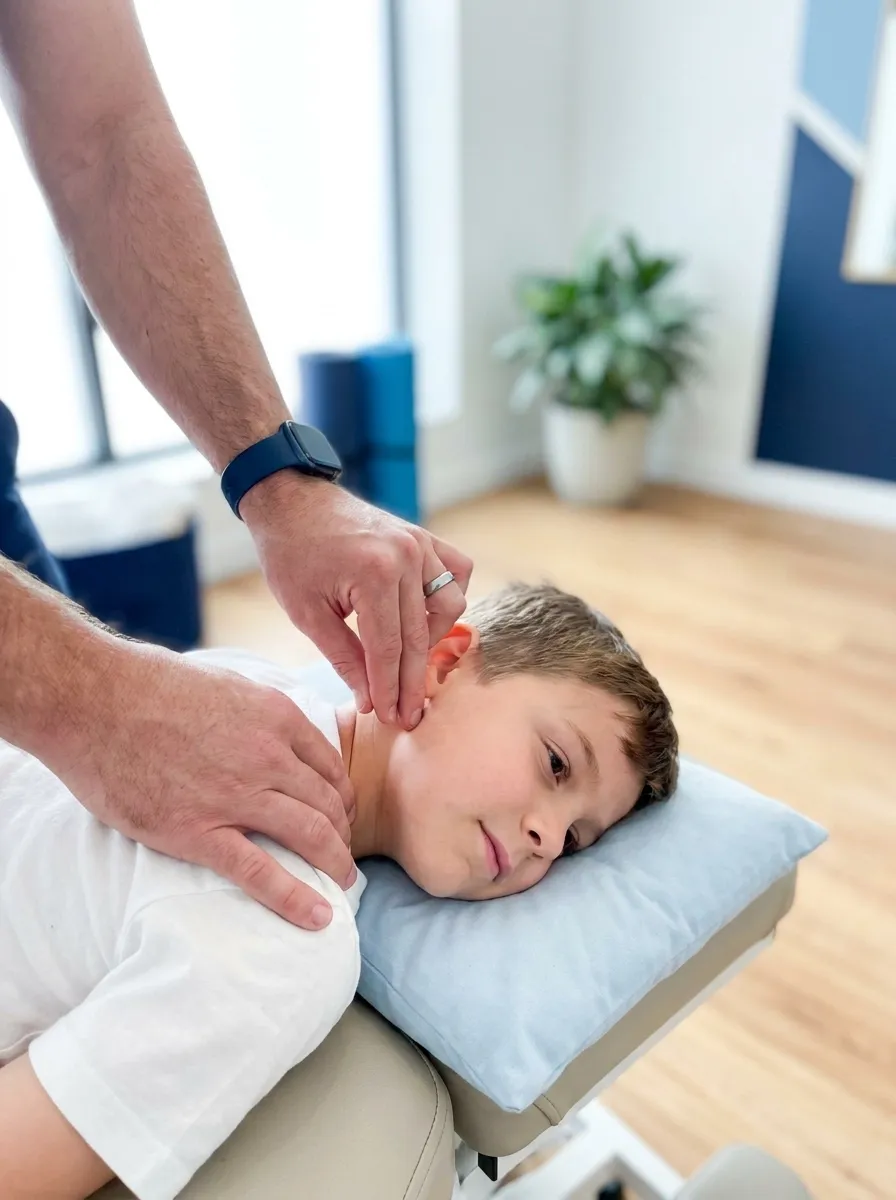
When a Child's Posture Calls for Pediatric Chiropractic Care
Children rarely describe a spine problem in those words. They say their neck is stiff, their head hurts again, or they do not want to finish practice. Parents notice other things: one shoulder sitting higher than the other, a backpack that always slides off the same side, a head that tilts the same way in every photo. Screens and year-round sports load a growing frame in ways that were uncommon a generation ago, and the pattern is easy to miss because it develops slowly, right in front of you.
Pediatric chiropractic care starts with looking, not adjusting. Dr. Bergtold measures posture, tests how each segment of the spine moves, checks foot and pelvic alignment, and screens for scoliosis so a structural curve is not mistaken for a postural one. Treatment is then matched to the finding and to the child: sustained fingertip pressure for an infant, a low-force instrument for a school-age child, a light hands-on adjustment for a teenager. Parents leave with a short home plan.
What Is Pediatric Chiropractic Care?
The Science of Gentle Joint Motion
Pediatric chiropractic care is the assessment and gentle treatment of a child's spine, pelvis and joints, scaled to age and size. The force used on an infant is a fraction of an adult adjustment. The National Center for Complementary and Integrative Health calls spinal manipulation one of the most studied manual therapies.
Restricted joint motion in a growing spine changes how a child sits, stands and carries a backpack, and shows up as a head tilt, an uneven shoulder or neck pain after school. Dr. Bergtold restores motion in those segments and adds cold laser therapy when soft tissue stays irritated.
Pediatric Chiropractic Treatment Areas
Concerns We See in Children
Scoliosis Monitoring
Curve screening and imaging to track changes during growth spurts
Postural Curves
Rounded shoulders and forward head posture from screens and backpacks
Neck and Back Pain
Joint restriction that leaves a child stiff or sore after school
Recurring Headaches
Tension patterns in the upper neck that trigger repeat headaches
Youth Sports Strain
Overuse and impact strain from practice, tumbling and contact sports
Infant Neck Preference
Turning consistently to one side or resisting head rotation

Benefits of Pediatric Chiropractic Care
Gentle Care, No Downtime






- 01
Age-Scaled Force
Pressure matched to your child's size, not to an adult spine
- 02
Early Scoliosis Detection
Screening that flags curves while a child is still growing
- 03
No Downtime
Children return to school, practice and play the same day
- 04
Drug-Free Approach
Addresses joint restriction without medication or injections
- 05
Home Exercise Plan
Simple daily stretches parents can supervise between visits
- 06
Whole-Body Assessment
Foot, pelvis and spine checked together, not in isolation
Pediatric Chiropractic Care vs. Alternatives

Who Is a Good Candidate for Pediatric Chiropractic Care?
Finding the Right Starting Point
Ideal Candidates for Pediatric Chiropractic Care
- Infants who consistently turn the head to one side or resist rotation
- School-age children with recurring headaches or stiffness after class
- Young athletes with overuse strain from practice, tumbling or contact sports
- Children with an uneven shoulder, waist crease or shoulder blade flagged at home or by a school screening
- Families who want a curve monitored through growth spurts rather than simply watched
- Parents comfortable supervising a short daily home exercise plan
Who Should Wait or Avoid Pediatric Chiropractic Care
- Suspected fracture, recent significant trauma or unexplained bone pain, until imaging clears it
- Active infection, fever or a child who is systemically unwell
- Known bone-weakening conditions such as osteogenesis imperfecta, or active malignancy
- Progressive neurological signs, which need medical evaluation first
What Happens During Pediatric Chiropractic Care
Step-by-Step Process
- 01
History
Dr. Bergtold reviews birth history, milestones, sports and where your child feels the problem.
- 02
Examination
He tests spinal motion, posture, foot and pelvic alignment, and screens for scoliosis.
- 03
Imaging
If a curve or injury is suspected, on-site X-ray separates structural from postural findings.
- 04
Parent Review
Dr. Bergtold explains the findings to you and your child in plain language before anything is done.
- 05
Adjustment
Fingertip pressure or a low-force instrument restores motion in the restricted segment.
- 06
Home Plan
You leave with two or three stretches and guidance on backpacks, screens and sleep.
Risks and Side Effects
What to Know
Common Side Effects
Most children have no reaction. When something does occur it is usually mild soreness in the treated area, or a short period of tiredness or fussiness, and it typically settles within 24 hours without treatment.
Rare Complications
Serious adverse events in children are rare in the published literature, and the reviews that exist call mainly for better reporting rather than describing a pattern of harm. Risk rises when force is not scaled to the child, or when an underlying problem such as a fracture, infection or bone-weakening disease has been missed. Screening comes before any adjustment for that reason.
Safety and Training
Doctors of chiropractic are licensed in every state and complete a minimum of four academic years of professional study, as outlined by the American Chiropractic Association. Dr. Bergtold uses fingertip pressure for infants and low-force instrumentation for children, and refers out when a finding sits outside the scope of chiropractic care.
Pediatric Chiropractic Care Cost in Naples
Pricing and Payment Options
How Much Does Pediatric Chiropractic Care Cost in Naples?
Cost depends on what the first visit involves: the examination itself, whether on-site X-ray imaging is needed to evaluate a suspected curve, and how many follow-up visits your child's plan calls for. Pediatric plans are usually shorter than adult plans. Call (239) 593-6788 and we will quote your child's situation before care begins.
Insurance and Coverage
Bergtold Chiropractic accepts Blue Cross Blue Shield, Aetna, Medicare, Medicare Advantage, UnitedHealthcare and Cigna. Coverage for pediatric visits varies by plan, so our team verifies benefits before your child starts care.
Flexible Payment Options
- CareCredit: healthcare financing with monthly payment plans
- Self-pay: per-visit pricing quoted to you before care begins
Dr. James Bergtold, DC reviews the findings and the expected number of visits with you, so there are no surprises. Contact our Naples office to get started.





Why Choose Bergtold Chiropractic for Pediatric Care in Naples
Naples Families Since 2000
25+ Years of Practice
More than 5,000 patients treated across Southwest Florida
On-Site Imaging
X-ray in the clinic to separate structural from postural curves
Sports Background
Former team chiropractor for First Baptist Academy football
Family Atmosphere
A bilingual team, unhurried visits and clear answers for parents
Rated 5.0 by Patients
A 5.0 Google rating from more than 200 Naples patient reviews
Gentle Techniques
Fingertip pressure and low-force instruments sized to a child's spine
Related Services
Other treatments Naples families combine with pediatric care.



Frequently Asked Questions About Pediatric Chiropractic Care
Your Questions Answered
How much does pediatric chiropractic care cost in Naples?
Cost for pediatric chiropractic care in Naples depends on the examination, whether on-site X-ray imaging is needed, and how many follow-up visits your child's plan calls for. Pediatric plans are usually shorter than adult plans. We accept Blue Cross Blue Shield, Aetna, Medicare, UnitedHealthcare and Cigna, and CareCredit financing is available. Call (239) 593-6788 for a quote before care begins.
Is chiropractic care safe for infants and children?
Pediatric chiropractic care is considered low risk when force is scaled to the child and screening comes first. Published reviews of adverse events in children describe mostly mild, short-lived soreness. Dr. Bergtold examines before he treats, uses fingertip pressure on infants, and refers out when a finding belongs with a pediatrician or an orthopedic specialist.
Does a pediatric adjustment hurt?
Most children report no pain. The pressure used on an infant is closer to what you would use to check a ripe tomato, and older children receive either a low-force instrument or a light hands-on adjustment. Some feel mild soreness for a day afterward, similar to the feeling after trying a new sport. Nothing is forced, and your child can stop at any point.
How long does pediatric chiropractic care take to work?
Parents often notice a change by the second or third visit. Fuller change usually takes four to eight visits and depends on how long the pattern has been present and how consistently the home stretches are done. Children generally respond faster than adults. Dr. Bergtold reassesses as you go rather than committing you to a long block of care up front.
How often will my child need to come in?
Most pediatric plans start at one to two visits a week for a few weeks, then taper. Once the complaint settles, many families move to periodic checkups during growth spurts or sports seasons. The plan is set after the examination, not before, and we tell you the expected number of visits when we review the findings.
What is the difference between pediatric chiropractic care and pediatric physical therapy?
Chiropractic care focuses on restoring motion in restricted spinal and pelvic joints, usually in short visits. Pediatric physical therapy focuses on developmental motor skills and strengthening over longer sessions. They address different problems and often work well together. If your child has a motor delay, physical therapy is the better starting point and we will say so.
Can chiropractic care correct my child's scoliosis?
No. Chiropractic care does not straighten a scoliotic curve. It can address the mobility and muscle tension around the curve, keep your child comfortable, and track the curve through growth with on-site imaging. Curves that progress need orthopedic input on bracing. Our scoliosis page explains how monitoring works.
At what age can a child see a chiropractor?
There is no minimum age. Newborns are seen for head-turning preference, toddlers after falls, school-age children for posture and neck pain, and teenagers for sports injuries. The technique changes at every stage, and a teenager who has finished growing may be treated much like an adult.
Do you take X-rays of children?
Only when the findings call for it. Dr. Bergtold uses on-site X-ray to distinguish a structural curve from a postural one, or to rule out injury after a significant fall or collision. Imaging is not routine for every child, and we explain why it is being recommended before anything is taken.
Can I bring my child while I am pregnant?
Yes, and many families schedule together. We provide prenatal chiropractic care in the same office, and our article on chiropractic care during pregnancy answers the common safety questions. Ask the front desk to book back-to-back appointments.
Schedule Your Consultation
References
- Misra et al., Clin Pediatr (Phila). (2025). Chiropractic Care in Children: A Review of Evidence and Safety. PMID: 39710943.
- Parnell et al., BMC Complement Altern Med. (2019). Manual therapy for the pediatric population: a systematic review. PMID: 30866915.
- Todd et al., J Manipulative Physiol Ther. (2015). Adverse Events Due to Chiropractic and Other Manual Therapies for Infants and Children: A Review of the Literature. PMID: 25439034.
- Horne et al., Am Fam Physician. (2014). Adolescent idiopathic scoliosis: diagnosis and management. PMID: 24506121.
- American Chiropractic Association. (2025). Doctors of chiropractic are licensed in all 50 states and complete a minimum of four academic years of professional study.