
Tendonitis Treatment in Naples, FL
Non-Invasive Care to Calm Inflammation and Restore Movement

What Is Tendonitis?
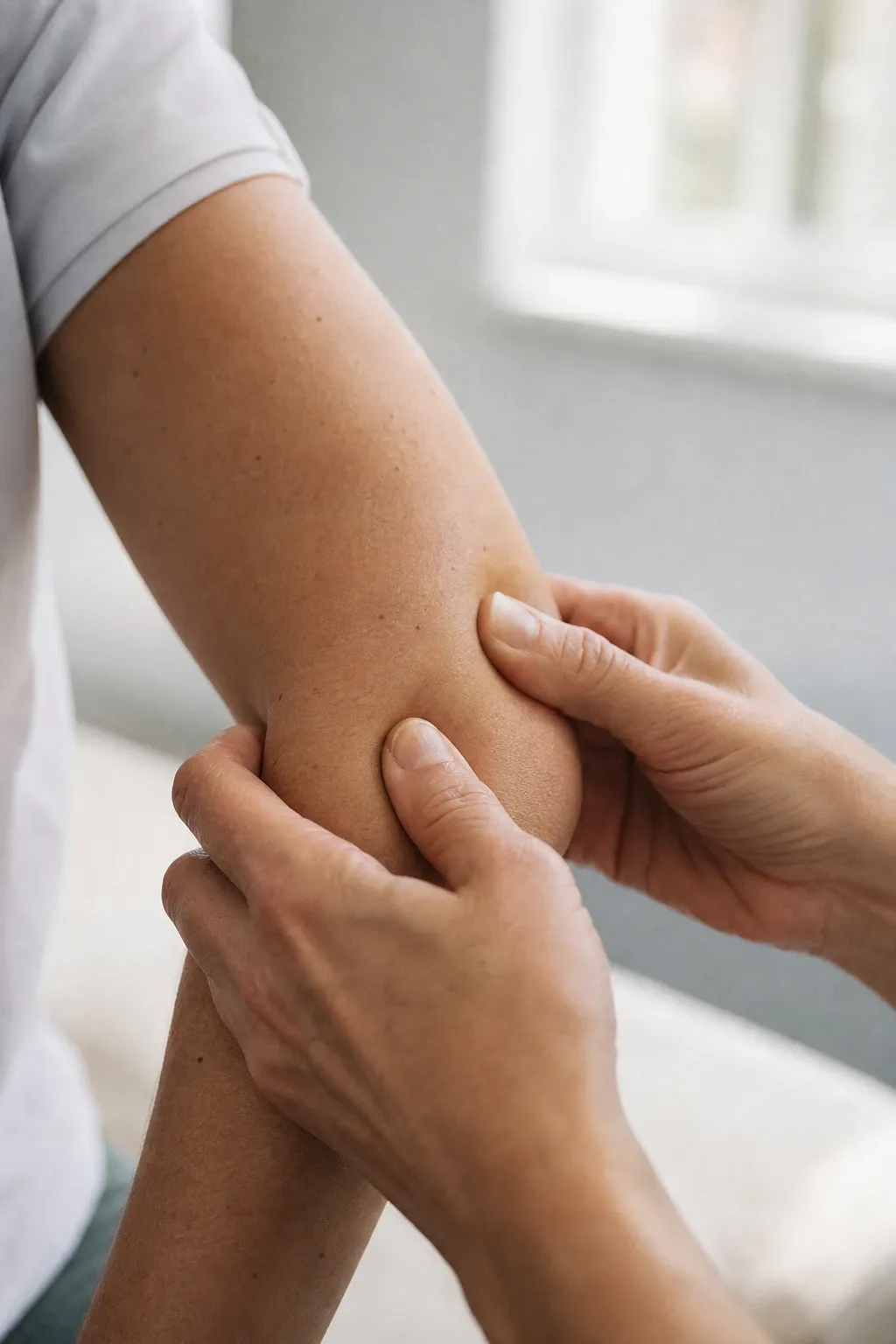
Tendonitis treatment in Naples, FL at Bergtold Chiropractic addresses pain, swelling and loss of strength in a tendon, the dense collagen cord that anchors muscle to bone, at the shoulder, elbow, knee, Achilles or heel, using shockwave and cold laser therapy to stimulate repair in tendons that have stopped healing on their own. Dr. James Bergtold, DC treats patients from Naples, Bonita Springs, Estero and Marco Island at Bergtold Chiropractic in Naples.
The tendons that give the most trouble are predictable. The rotator cuff at the shoulder, the common extensor tendon at the outside of the elbow, the patellar tendon just below the kneecap, the Achilles at the back of the ankle, and the gluteal tendons at the outside of the hip account for the large majority of cases we see in Naples.
The pattern is what patients recognize first. The tendon is stiff and sore for the first few minutes of activity, warms up and feels better in the middle, then aches for hours afterward and is at its worst the next morning. Patients tell us they have stopped serving in tennis, stopped reaching into the top cabinet, or started walking flat-footed off the first step of the morning.
- 01 Why Tendonitis Happens
- 02 Degeneration, Not Just Inflammation
- 03 What Accelerates Tendonitis?
- 04 Why Choose Bergtold Chiropractic for Tendonitis Care in Naples, FL
- 05 Treatment Options Comparison
- 06 You May Be Experiencing Tendonitis If...
- 07 Related Services
- 08 Frequently Asked Questions
- 09 Scientific References

Why Tendonitis Happens
Tendon is living tissue that adapts to the load you place on it. Collagen turns over slowly, on the order of months rather than days, so a tendon needs time between hard efforts to lay down and organize new fibers. When load rises faster than that repair rate, and a sudden jump in mileage, a new racket sport, or a week of overhead work is usually enough, microscopic damage accumulates faster than it is cleared. The National Institute of Arthritis and Musculoskeletal and Skin Diseases identifies repetitive motion and sudden increases in activity as the leading causes of tendon injury.
What follows is a failed healing response rather than a simple inflammatory one. Collagen fibers lose their parallel alignment, water content in the tendon rises, and the matrix around the fibers softens. New blood vessels grow into the damaged zone carrying sensory nerve fibers with them, which is a large part of why a degenerated tendon hurts even though little classic inflammation is present. A tendon in that state is weaker and stiffer than healthy tissue, so it keeps failing at lower and lower loads.
Alignment decides which tendon takes the hit. A restricted mid-back and a forward shoulder narrow the space the rotator cuff passes through. An unlevel pelvis or a collapsed arch rotates the thigh inward and drags the patellar tendon and iliotibial band through an angle they were not built for, which is why tendon pain, knee pain and plantar fasciitis so often turn up in the same leg. Dr. Bergtold assesses the joints above and below the painful tendon before treating the tendon itself, because a tendon returned to the same faulty line tends to break down again.
Degeneration, Not Just Inflammation
Most patients arrive having already tried the standard sequence: rest, ice, a brace and several weeks of ibuprofen. That approach is aimed at inflammation, and in a chronic tendon there is not much inflammation left to treat. Pain settles while the tendon is unloaded, then returns within days of resuming normal activity, because the underlying collagen disorganization was never addressed. Complete rest can make matters worse, since a tendon that is not loaded at all continues to lose tensile strength.
Two things change the tissue itself. The first is graduated mechanical loading. Controlled, progressively heavier work through the tendon signals the cells inside it to lay down new collagen and realign existing fibers, and randomized trials in patellar and Achilles tendinopathy have found progressive loading programs to be among the most reliable conservative treatments available. Isometric holds are often used early because they reduce tendon pain without adding the strain of full-range work.
The second is stimulating a repair response in tissue that has stalled. Shockwave therapy delivers acoustic pulses into the tendon and its attachment to bone, which promotes new collagen formation and appears to disrupt the ingrown nerve fibers that carry the pain signal. Cold laser therapy works on the surrounding soft tissue, targeting swelling and pain so that loading work becomes tolerable sooner. The same pairing is what we use for tendon-driven sports injuries in Naples athletes.
What Accelerates Tendonitis?
Identifying Your Triggers
Sudden Load Increases
A jump in mileage, a new racket sport or a weekend of overhead work outpaces the tendon's slow repair rate.
Repetitive Daily Motion
Gripping tools, typing, painting and lifting drive the same tendon through thousands of identical cycles.
Joint Restriction Above and Below
A stiff mid-back or an unlevel pelvis changes the angle a tendon pulls through, concentrating strain in one spot.
Foot and Arch Mechanics
A collapsing arch rotates the leg inward and loads the Achilles and patellar tendons unevenly with every step.
Age-Related Collagen Change
After roughly age 30, tendons hold less water and repair more slowly, so the same activity carries more risk.
Metabolic and Medication Factors
Diabetes, thyroid disease, high cholesterol and fluoroquinolone antibiotics are all linked to weaker tendon tissue.
Why Choose Bergtold Chiropractic for Tendonitis Care in Naples, FL
Expert Care in Naples
Treats The Cause, Not The Sore Spot
We assess the joints above and below the tendon first, because the loading angle is what keeps it failing
Regenerative Technology On Site
SoftWave acoustic therapy and MLS robotic laser are both in the clinic, with no outside referral needed
Loading Plans, Not Just Passive Care
Treatment is paired with graduated tendon loading, the approach with the strongest research support
Unhurried Appointments
Forty years of practice and no cookie-cutter templates, so your plan comes from your exam findings
On-Site X-Ray Imaging
Imaging in the office rules out a fracture, arthritic change or a calcific deposit before a loading plan is written
Rated 5.0 By Patients
A 5.0 Google rating from more than 200 reviews, with major insurance and CareCredit accepted
Treatment Options Comparison
You May Be Experiencing Tendonitis If...
Recognizing When to Seek Help
Pain That Warms Up
The first few minutes of activity hurt, the middle feels almost normal, and the ache returns hours later.
Worst In The Morning
The tendon is stiff and sore for your first steps or first reach of the day, then loosens as you move.
Tender To Touch
You can press one specific spot on the tendon and reproduce the pain, often at its attachment to bone.
Pain On Loading, Not At Rest
Sitting still is comfortable, but pushing, gripping, climbing stairs or pushing off reliably brings it back.
Weakness Without Numbness
The limb feels weaker or unreliable, but there is no tingling or numbness, which points away from a nerve cause.
Months, Not Days
It has come and gone for six weeks or longer, easing with rest and returning as soon as you resume activity.
Related Services
Treatments we use for tendonitis at our Naples clinic.
Frequently Asked Questions
About Tendonitis
What is the difference between tendonitis and tendinopathy?
Tendonitis means active inflammation, which is what happens in the first days after an injury. Tendinopathy describes what most long-standing cases actually are: a failed healing response with disorganized collagen and very few inflammatory cells. The distinction matters because it explains why anti-inflammatories help early on and disappoint later, and why loading and shockwave work better in chronic cases.
Why did rest and ibuprofen not fix my tendonitis?
Both target inflammation, and in a tendon that has hurt for more than a few weeks there is usually little inflammation left. Pain settles while you are resting and returns within days of resuming activity because the underlying collagen disorganization was never addressed. Complete rest can also weaken the tendon further, since tendon tissue needs controlled load to rebuild.
Which tendons do you treat most often?
The rotator cuff at the shoulder, the common extensor tendon at the outside of the elbow, the patellar tendon below the kneecap, the Achilles at the back of the ankle, and the gluteal tendons at the outside of the hip. These five account for most cases we see. Treatment principles are similar across sites, though loading exercises and session counts differ.
How does shockwave therapy help a tendon?
Shockwave delivers acoustic pulses into the tendon and its attachment to bone, which prompts new collagen formation in tissue that has stopped repairing on its own. Studies suggest it also disrupts the ingrown nerve fibers that carry the pain signal. Most patients need four to six sessions, and it is typically paired with a graduated loading program rather than used alone.
How long does tendonitis take to get better?
Most patients notice a change within three to four weeks, usually less morning stiffness and a shorter ache after activity. Fuller recovery typically takes six to twelve weeks. Tendon collagen turns over slowly, so a case that has been present for a year rarely resolves in a month. Achilles and gluteal tendons generally take longer than elbow tendons.
Should I keep exercising with tendonitis?
In most cases yes, with the load adjusted. Studies suggest that progressive tendon loading is the most reliable conservative treatment, and prolonged rest tends to leave the tendon weaker. The usual approach is to reduce the aggravating activity rather than stop moving, add isometric holds early for pain relief, then build strength as symptoms allow.
How much does tendonitis treatment cost in Naples?
Cost depends on your exam findings, how many visits your plan calls for, and whether shockwave, laser or imaging is included. We accept Blue Cross Blue Shield, Aetna, Medicare, Medicare Advantage, UnitedHealthcare and Cigna, and CareCredit financing is available. Call (239) 593-6788 and we will quote your case directly.
When should I see someone about tendon pain?
Consider an exam if pain lasts beyond two to three weeks, keeps returning after rest, or limits your work or sport. Seek prompt medical evaluation if you felt a pop and lost strength suddenly, cannot bear weight, or have marked swelling and bruising, since those can indicate a tendon tear rather than a degenerative problem.
Schedule Your Consultation
Scientific References
- Breda et al., Br J Sports Med. (2021). Effectiveness of progressive tendon-loading exercise therapy in patients with patellar tendinopathy: a randomised clinical trial. PMID: 33219115.
- Cooper et al., Health Technol Assess. (2023). Exercise therapy for tendinopathy: a mixed-methods evidence synthesis exploring feasibility, acceptability and effectiveness. PMID: 37929629.
- Silbernagel et al., J Athl Train. (2020). Current Clinical Concepts: Conservative Management of Achilles Tendinopathy. PMID: 32267723.
- Littlewood et al., Physiotherapy. (2012). Exercise for rotator cuff tendinopathy: a systematic review. PMID: 22507359.
- Charles et al., Front Immunol. (2023). The effectiveness of shockwave therapy on patellar tendinopathy, Achilles tendinopathy, and plantar fasciitis: a systematic review and meta-analysis. PMID: 37662911.
- Xue et al., BMC Musculoskelet Disord. (2024). Effect of extracorporeal shockwave therapy for rotator cuff tendinopathy: a systematic review and meta-analysis. PMID: 38704572.
- American Chiropractic Association. (2025). Professional guidance on conservative management of repetitive strain and soft tissue injury.