
Sports Injury Treatment in Naples, FL
Recovery Care to Get You Back to Peak Performance
What Are Sports Injuries?
Sports injury treatment in Naples, FL at Bergtold Chiropractic covers acute injuries such as sprains, strains and collisions as well as overuse injuries that build over weeks of training, using adjustments, shockwave and cold laser therapy to restore function and reduce the risk of reinjury. Dr. Bergtold has trained with elite athletes and returns patients to play safely. Dr. James Bergtold, DC treats patients from Naples, Bonita Springs, Estero and Marco Island at Bergtold Chiropractic in Naples.
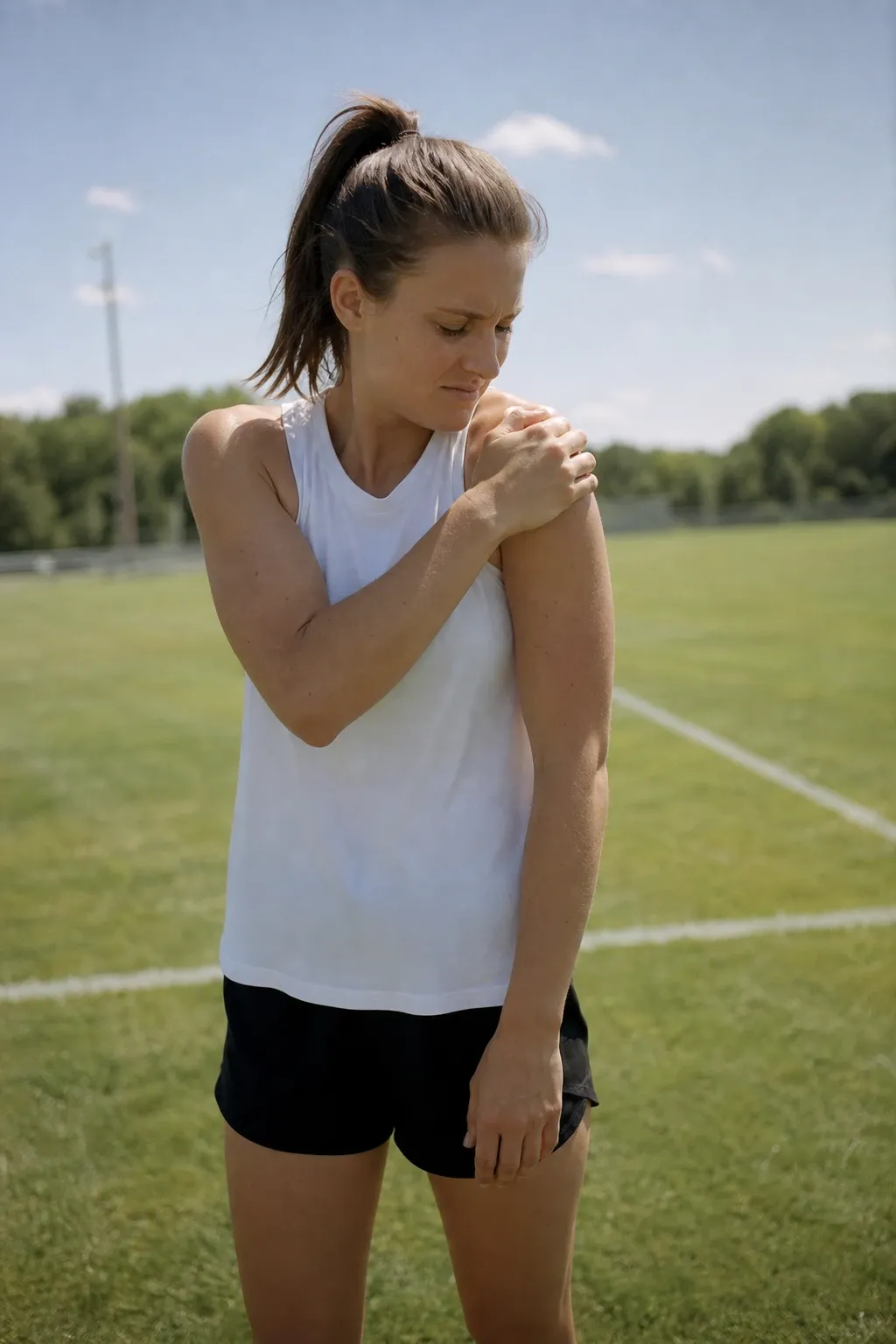
The difference usually announces itself. An acute injury has a moment you can name, a pop or a twist you remember exactly. An overuse injury has no moment at all: the shoulder that only aches after serving, the shin that hurts for the first mile then quiets down, the knee that swells the morning after a match rather than during it.
The cost is the same either way. Patients tell us they dropped down a league, stopped running the Greenway, gave up the Saturday pickleball game, or spent an entire season managing pain instead of training. Most sports injuries respond well to conservative care, and the ones that do not are usually identifiable early if someone examines you properly.
- 01 Why Sports Injuries Happen
- 02 Return to Play and Reinjury Risk
- 03 What Accelerates Sports Injuries?
- 04 Why Choose Bergtold Chiropractic for Sports Injury Care in Naples, FL
- 05 Treatment Options Comparison
- 06 You May Be Dealing With a Sports Injury If...
- 07 Related Services
- 08 Frequently Asked Questions
- 09 Scientific References
Why Sports Injuries Happen
Tissue adapts to load, but each type adapts at its own pace. Muscle and bone remodel relatively quickly, while tendon and ligament remodel slowly. A training block that adds volume faster than tendon can respond creates a mismatch that surfaces as pain two or three weeks later, long after the session that caused it. The National Institute of Arthritis and Musculoskeletal and Skin Diseases identifies training errors and inadequate recovery as leading contributors to sports injuries at every level of competition.
Where the tissue fails is rarely random. A restricted joint forces the joint next to it to make up the difference. A stiff mid-back makes the shoulder rotate further to reach overhead. A locked-up hip pushes rotation down into the knee and back into the lower spine. The painful structure is usually downstream of the restricted one, which is why knee pain in a runner and plantar fasciitis in the same athlete often trace back to one stiff hip.
Once tissue is injured, the repair response itself can stall. Chronically overloaded tendon develops disorganized collagen fibers and a poor local blood supply, which is why some injuries plateau at seventy percent and stay there for months. Shockwave therapy delivers acoustic pulses into that tissue to restart a repair response, while cold laser therapy targets the inflammation and pain that keep an athlete from loading the area at all.
Return to Play and Reinjury Risk
Reinjury is the reason return-to-play decisions matter more than they appear to. Risk is highest in the first weeks after an athlete returns, and studies suggest that the strongest single predictor of a hamstring or ankle injury is having had one before. Pain going away is not the same thing as tissue being ready, and neither one means the movement pattern that produced the injury has changed.
Dr. Bergtold trained alongside doctors who work with USA Olympic team athletes and NFL players, and served as team chiropractor for the First Baptist Academy football team. Sideline work teaches a specific discipline: athletes are cleared on objective criteria, not on how badly they want to play Friday night. Full pain-free range compared to the uninjured side, strength within a reasonable margin of the other limb, and sport-specific movement performed at speed without visible compensation.
Preventing the second injury is movement correction, not rest. Restoring joint motion with chiropractic adjustments gives the athlete access to range they were borrowing from somewhere else, and progressive loading rebuilds the tissue's tolerance for that range. The same principle applies whether the presentation is tendonitis in a throwing shoulder or a hamstring that tears every spring.
What Accelerates Sports Injuries?
Identifying Your Triggers
Training Load Spikes
Adding distance, weight or intensity faster than tendon and bone can remodel produces pain two to three weeks later.
Restricted Joint Motion
A stiff hip, ankle or mid-back forces the joint beside it to absorb range it was never designed to provide.
Strength And Control Gaps
When the glutes or rotator cuff cannot control a limb at speed, smaller tissue downstream takes the rotational load.
Inadequate Recovery
Short sleep, back-to-back tournaments and Florida heat all slow the repair cycle that happens between sessions.
Previous Untreated Injury
An old sprain that healed with altered mechanics leaves a compensation pattern that quietly sets up the next injury.
Technique And Equipment
Worn shoes, a poor serve pattern or a lifting form fault concentrate force in the same tissue every single repetition.
Why Choose Bergtold Chiropractic for Sports Injury Care in Naples, FL
Expert Care in Naples
Sideline Experience
Care shaped by high school football team coverage and training alongside doctors for Olympic and NFL athletes
Objective Return To Play
You are cleared on range, strength and sport-specific movement testing, not on how soon you want to be back
Imaging And Honest Referral
On-site X-ray, and a direct orthopedic referral when the exam points to something conservative care will not fix
Advanced Recovery Technology
SoftWave acoustic therapy, MLS robotic laser and Hill DT decompression available under one roof
Certified In Regenerative Tools
Formal certification in SoftWave acoustic therapy and MLS robotic laser operation, used to move stalled healing along
Rated 5.0 By Patients
A 5.0 Google rating from more than 200 reviews, with major insurance and CareCredit accepted
Treatment Options Comparison
You May Be Dealing With a Sports Injury If...
Recognizing When to Seek Help
Pain That Outlasts Rest
You took a week off, felt fine, then the same pain returned within two sessions of going back to your sport.
A Pop Or Tear You Felt
There was a distinct moment during play, and the area swelled, bruised or refused to take weight afterward.
Pain Arriving Earlier
What used to start at mile three now starts at mile one, a classic sign that tissue tolerance is dropping.
Swelling After Activity
The joint puffs up in the hours after a game or a run, settles overnight, then does the same thing next time.
Guarding And Compensation
You have changed how you run, serve or lift to avoid a position, often without consciously deciding to.
No Confidence In The Limb
The knee, ankle or shoulder feels unreliable at speed and you are holding back on cuts, jumps or throws.
Related Services
Treatments we use for sports injury recovery at our Naples clinic.
Frequently Asked Questions
About Sports Injuries
Can a chiropractor treat sports injuries?
For most soft tissue and joint injuries, yes. Dr. Bergtold restores motion in the restricted joints that set the injury up, then uses shockwave or laser on the damaged tissue itself. What chiropractic care does not treat is a fracture, a complete tendon rupture or an unstable joint. Those get imaged and referred.
How soon can I get back to my sport?
It depends on the tissue and the sport, not the calendar. Minor strains often clear in two to three weeks, while tendon problems typically take six to eight. Dr. Bergtold clears athletes on objective criteria: full pain-free range against the other side, comparable strength, and sport-specific movement at speed without compensating.
Do I need an X-ray or MRI for a sports injury?
Not usually, but sometimes. We take X-rays on site when the exam suggests a fracture, a bone stress injury, or a growth plate problem in a young athlete. MRI is for suspected ligament tears, meniscus damage and rotator cuff tears, and we coordinate that referral rather than treating around an unknown.
When does an injury need an orthopedic surgeon instead?
Certain findings point past conservative care. A joint that cannot bear weight, obvious deformity, a limb that gives way completely, a torn ligament with instability on testing, or pain that does not budge across a full treatment plan. Dr. Bergtold will tell you plainly when that is your situation and refer you out.
Why does the same injury keep coming back?
Because pain resolving and the cause resolving are two different things. Reinjury risk is highest in the first weeks back, and the movement fault that overloaded the tissue is usually still there. Restoring joint motion and then progressively loading the area is what changes the pattern rather than just calming the symptoms.
Shockwave or cold laser: which one is right for me?
Cold laser suits acute inflammation and pain, and most patients feel a change within three to six sessions. Shockwave suits stalled tendon and soft tissue repair, the injuries that stopped improving months ago, and typically works across four to eight weeks. Your exam findings decide, and some cases use both.
How much does sports injury treatment cost in Naples?
Cost depends on your exam findings, how many visits your plan calls for, and whether imaging or added therapies such as shockwave or laser are included. We accept Blue Cross Blue Shield, Aetna, Medicare, Medicare Advantage, UnitedHealthcare and Cigna, and CareCredit financing is available. Call (239) 593-6788 for a quote on your case.
Schedule Your Consultation
Scientific References
- Wojtys et al., Sports Health. (2017). Sports Injury Prevention. PMID: 28225690.
- Hübscher et al., Med Sci Sports Exerc. (2010). Neuromuscular training for sports injury prevention: a systematic review. PMID: 19952811.
- Stephenson et al., Orthop J Sports Med. (2021). A Comprehensive Summary of Systematic Reviews on Sports Injury Prevention Strategies. PMID: 34734094.
- Charles et al., Front Immunol. (2023). The effectiveness of shockwave therapy on patellar tendinopathy, Achilles tendinopathy, and plantar fasciitis: a systematic review and meta-analysis. PMID: 37662911.
- Silbernagel et al., J Athl Train. (2020). Current Clinical Concepts: Conservative Management of Achilles Tendinopathy. PMID: 32267723.
- American Chiropractic Association. (2025). Professional guidance on conservative management of sports and musculoskeletal injuries.