
Herniated Disc Treatment in Naples, FL
Non-Surgical Treatment to Relieve Pain and Support Disc Healing


What Is a Herniated Disc and Why Does It Hurt?
Herniated disc treatment in Naples, FL at Bergtold Chiropractic addresses the pain that follows when the soft inner core of a spinal disc pushes through a tear in its outer ring and crowds a nearby nerve root, most often at L4-L5 or L5-S1 in the low back and C5-C6 or C6-C7 in the neck. Non-surgical decompression helps the disc resorb and the nerve recover. Dr. James Bergtold, DC treats patients from Naples, Bonita Springs, Estero and Marco Island at Bergtold Chiropractic in Naples.
When you feel a deep ache in the low back that turns into a sharp line of pain running down one leg, or a burning band that travels from the neck into the arm and hand, you are describing the classic herniated disc pattern. Coughing, sneezing and bending forward usually make it sharper for a few seconds.
Bending to load the dishwasher, sitting through the drive to Bonita Springs and rolling over in bed become the moments you brace for. Most herniated discs improve with conservative care, and research shows a large share of them shrink on their own over the months that follow.
- 01 Why a Herniated Disc Happens
- 02 How a Herniated Disc Resorbs
- 03 What Triggers and Worsens a Herniated Disc?
- 04 Why Choose Bergtold Chiropractic for Herniated Disc Care in Naples, FL
- 05 Treatment Options Comparison
- 06 You May Be Experiencing a Herniated Disc If...
- 07 Related Services
- 08 Frequently Asked Questions
- 09 Scientific References

Why a Herniated Disc Happens
Spinal discs are roughly 80 percent water in early adulthood and lose fluid steadily with age, which flattens the cushion and leaves the outer ring stiffer and easier to tear. Once small radial tears form in the annulus, ordinary load can push nucleus material outward into the canal. The National Institute of Neurological Disorders and Stroke lists disc herniation among the most common structural causes of low back pain and radiating leg pain.
Pressure is only part of the story. Displaced nucleus material is chemically inflammatory, so it irritates the nerve root even when the bulge is small. That is why a modest herniation on imaging can produce severe leg pain while a larger one sometimes causes very little, and why symptoms often ease well before the disc itself has changed shape.
Because the pain generator sits in the spine rather than in the limb, care aimed only at the sore leg or arm tends to fall short. Dr. Bergtold images the involved region first, then unloads the segment with spinal decompression. A herniated disc is also the most common source of sciatica and a frequent driver of persistent back pain.
How a Herniated Disc Resorbs
The body treats displaced disc material as foreign tissue. Once nucleus pulposus breaches the annulus and meets the blood supply in the epidural space, immune cells migrate in, new capillaries form, and enzymes begin breaking the fragment down. Radiologists call this spontaneous resorption, and it is the reason many herniations look smaller on repeat imaging.
Meta-analyses of conservatively treated lumbar herniations report spontaneous resorption in roughly two thirds of cases, with extruded and sequestered fragments regressing more often than contained bulges. Studies suggest the process typically unfolds over three to twelve months, which matches the timeline most patients experience clinically.
Conservative care is aimed at supporting that window: reducing mechanical load on the segment, calming the inflammatory response around the nerve root, and keeping you moving while the disc changes. Cases with a strong inflammatory component frequently add cold laser therapy, and radiating arm and leg pain is tracked as it retreats from the hand or foot back toward the spine, a pattern clinicians call centralization.
What Triggers and Worsens a Herniated Disc?
Identifying Your Triggers
Age-Related Disc Drying
Discs lose water content from the twenties onward, flattening the cushion and leaving the outer ring stiffer and easier to tear.
Bending and Lifting
Loading the spine while bent forward and rotated is the classic moment a weakened annulus gives way, common in yard work and gym lifts.
Prolonged Sitting
Sitting raises pressure inside the lumbar discs, so long drives and desk days keep pushing nucleus material toward an existing tear.
Sudden Trauma
Car collisions, falls and hard tackles can herniate a disc in one event, sometimes with leg or arm symptoms arriving days later.
Repetitive Vibration
Hours in a boat, a truck or heavy equipment expose the discs to constant micro-loading that speeds up degeneration.
Body Weight and Smoking
Extra load increases compressive force on the lumbar discs, while smoking narrows the small vessels that feed them.
Why Choose Bergtold Chiropractic for Herniated Disc Care in Naples, FL
Expert Care in Naples
On-Site X-Ray Diagnostics
Imaging at the Naples office helps identify the involved level and rule out other structural causes before care begins.
Hill DT Decompression Certified
Dr. Bergtold is certified in cervical and lumbar Hill DT decompression, which unloads the disc in measured cycles.
Root-Cause Treatment Plans
Care targets the spinal segment crowding the nerve, not only the arm or leg where you happen to feel the pain.
Referral When It Is Warranted
Progressive weakness and red-flag symptoms are referred out promptly rather than managed with repeat visits.
Therapies That Work Together
MLS robotic laser and SoftWave acoustic therapy calm the inflamed tissue around the disc between decompression sessions.
Rated 5.0 by Patients
A 5.0 Google rating from more than 200 Naples reviews, with major insurance accepted and CareCredit financing available.
Treatment Options Comparison
You May Be Experiencing a Herniated Disc If...
Recognizing When to Seek Help
Pain That Travels
The pain runs from your low back into the buttock and down one leg past the knee, or from the neck into the arm and hand.
Worse With Coughing
Coughing, sneezing or straining sends a sharp spike through the back, a sign that pressure inside the disc is involved.
One-Sided Symptoms
Symptoms follow one limb rather than both, and that side feels distinctly different when you stand, walk or reach overhead.
Numbness or Tingling
Pins and needles or a numb patch appears in a defined band, such as the outer calf, the top of the foot or two fingers.
Worse Sitting and Bending
Twenty minutes in the car or leaning over the sink builds the pain, and standing up brings a jolt before it eases off.
Grip or Foot Weakness
Your foot catches on stairs or your grip drops objects. Weakness warrants prompt evaluation rather than watchful waiting.
Related Services
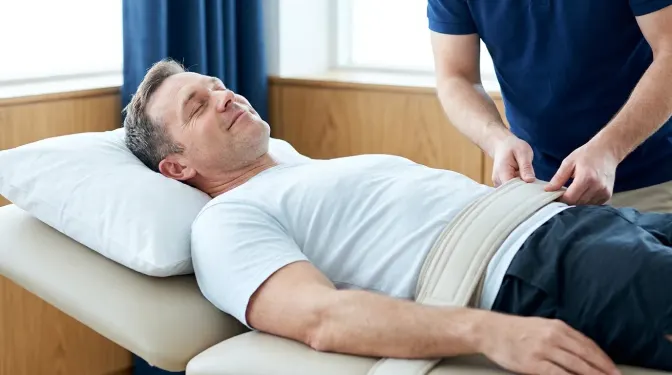
Non-surgical treatments we use for herniated disc pain in Naples.
Frequently Asked Questions
About Herniated Discs
How long does a herniated disc take to heal?
Most herniated discs settle within six to twelve weeks of conservative care, though the disc itself can keep remodeling for several months after the pain fades. The signal we watch for is centralization: pain that once reached the foot or hand now stops closer to the spine. Timelines vary with the size of the herniation and how long the nerve has been compressed.
Can a herniated disc heal on its own?
Often, yes. Meta-analyses of conservatively managed lumbar herniations report spontaneous resorption in roughly two thirds of cases, and larger extruded fragments tend to shrink more reliably than smaller contained bulges. Conservative care supports that process by unloading the segment and calming inflammation around the nerve root while your body reabsorbs the displaced material.
Do I need an MRI or surgery for a herniated disc?
Most patients need neither. On-site X-ray shows disc height, alignment and arthritic change, which is usually enough to plan conservative care. We refer for MRI or a surgical opinion when symptoms are not improving, when weakness is progressing, or when the clinical picture warrants it. Surgery is typically reserved for cases that fail a reasonable course of non-surgical treatment.
What symptoms mean I should go to the emergency room?
Go to an emergency department right away if you develop numbness across the saddle area of the inner thighs, buttocks or groin, any new loss of bladder or bowel control, or leg weakness that is getting worse. That combination can point to cauda equina syndrome, a surgical emergency. Do not wait for a chiropractic appointment. Call 911 if you cannot get there safely.
Is chiropractic care safe for a herniated disc?
For most patients it is a reasonable non-drug option, and Dr. Bergtold images the region first specifically to identify the cases that need a different approach. Some soreness for a day or two after early visits is common. Progressive weakness, saddle numbness or bladder and bowel changes are red flags that call for emergency evaluation instead.
What can I do at home between visits?
Short, frequent walks, changing position every 20 to 30 minutes, and avoiding bent-forward lifting help most patients hold their progress. Ice over the involved area can calm an acute flare in the first few days. Dr. Bergtold prescribes specific positions and movements based on which level is involved, since what helps one disc level can aggravate another.
Does insurance cover herniated disc care at your Naples office?
We accept Blue Cross Blue Shield, Aetna, Medicare, Medicare Advantage, UnitedHealthcare and Cigna, and coverage for decompression varies by plan. CareCredit financing is available for anything not covered. Cost depends on how many visits and which therapies your case needs, so call (239) 593-6788 and we will review your benefits first.
Schedule Your Consultation
Scientific References
- Zou et al., Clin Spine Surg. (2024). Incidence of Spontaneous Resorption of Lumbar Disc Herniation: A Meta-analysis. PMID: 37559207.
- Yu et al., Arthritis Res Ther. (2022). Characteristics and mechanisms of resorption in lumbar disc herniation. PMID: 35999644.
- Hahne et al., Spine (Phila Pa 1976). (2010). Conservative management of lumbar disc herniation with associated radiculopathy: a systematic review. PMID: 20421859.
- Choi et al., Int J Clin Pract. (2022). Effect of Nonsurgical Spinal Decompression on Intensity of Pain and Herniated Disc Volume in Subacute Lumbar Herniated Disc. PMID: 36263240.
- Demirel et al., J Back Musculoskelet Rehabil. (2017). Regression of lumbar disc herniation by physiotherapy. Does non-surgical spinal decompression therapy make a difference? Double-blind randomized controlled trial. PMID: 28505956.
- National Institute of Neurological Disorders and Stroke. (2024). Cauda equina syndrome, marked by saddle numbness and loss of bladder or bowel control, is described as a medical emergency requiring immediate care.